


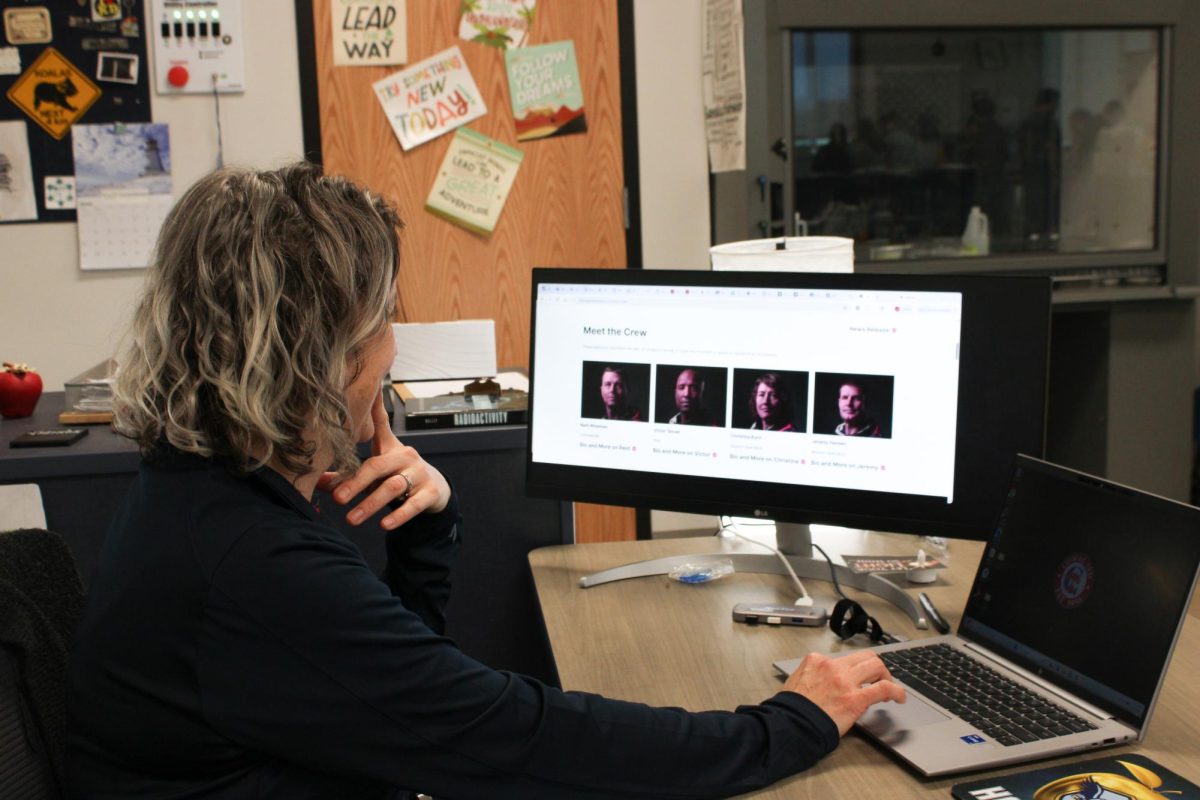
The Artemis II launch is a lunar flyby mission led by NASA that is set to be the first manned lunar mission to come in vicinity of the moon since the Apollo 17 mission in 1972.
The mission launch is planned for March 2026, and is set to last 10 days. The mission objective is to test the Orion spacecraft systems, such as life support, navigation and crew performance, for future deep space lunar missions. The crew is not set to land on the moon but will travel farther than any humans have before, with the spacecraft designated to fly about 4,000 miles beyond the far side of the moon and approximately 257,000 miles away from Earth. The mission crew consists of four astronauts: Commander Reid Wisemen, Pilot Victor Glover, and Mission Specialists Christina Koch and Jeremy Hansen.
“I was excited and fascinated that we would be resuming exploration of the moon,” chemistry and AP physics teacher Mrs. Jennifer Russell said. “I hadn’t paid much attention to space since I was a kid, but when we [the Russell family] visited NASA in November, this fascination and childlike wonder resurfaced.”
While important milestones like this mission may seem distant from a classroom setting, opportunities can emerge for learning experiences in academics.
“I know NASA has several learning opportunities that I think are super engaging for students,” sophomore Gracelyn Wilkinson said. “It helps us understand all sorts of things that are ‘out there,’ like how the Earth works in our solar system and things like the general chemical makeup of our universe.”
While the mission is significant, it has sparked discourse among whether it should be a primary objective in modern society.
“[Space exploration is] important but not a priority,” Russell said. “There are environmental issues and energy issues that surround and affect each of us. The world is full of wars, and I think one must first take care of themselves and their ‘home planet’ before expanding.”
Projects like this aren’t only milestones, they are a way to promote the future of exploration and provide inspiration for future generations.
“I think students should always be encouraged to look into science,” senior and National Science Honors Society founder Zander Abolos said. “It provides hope and motivation with these four brave astronauts going to space on this dangerous mission.”





Marisol Aguilar • Feb 6, 2026 at 4:33 pm
I love this story! Great job, Jacob!