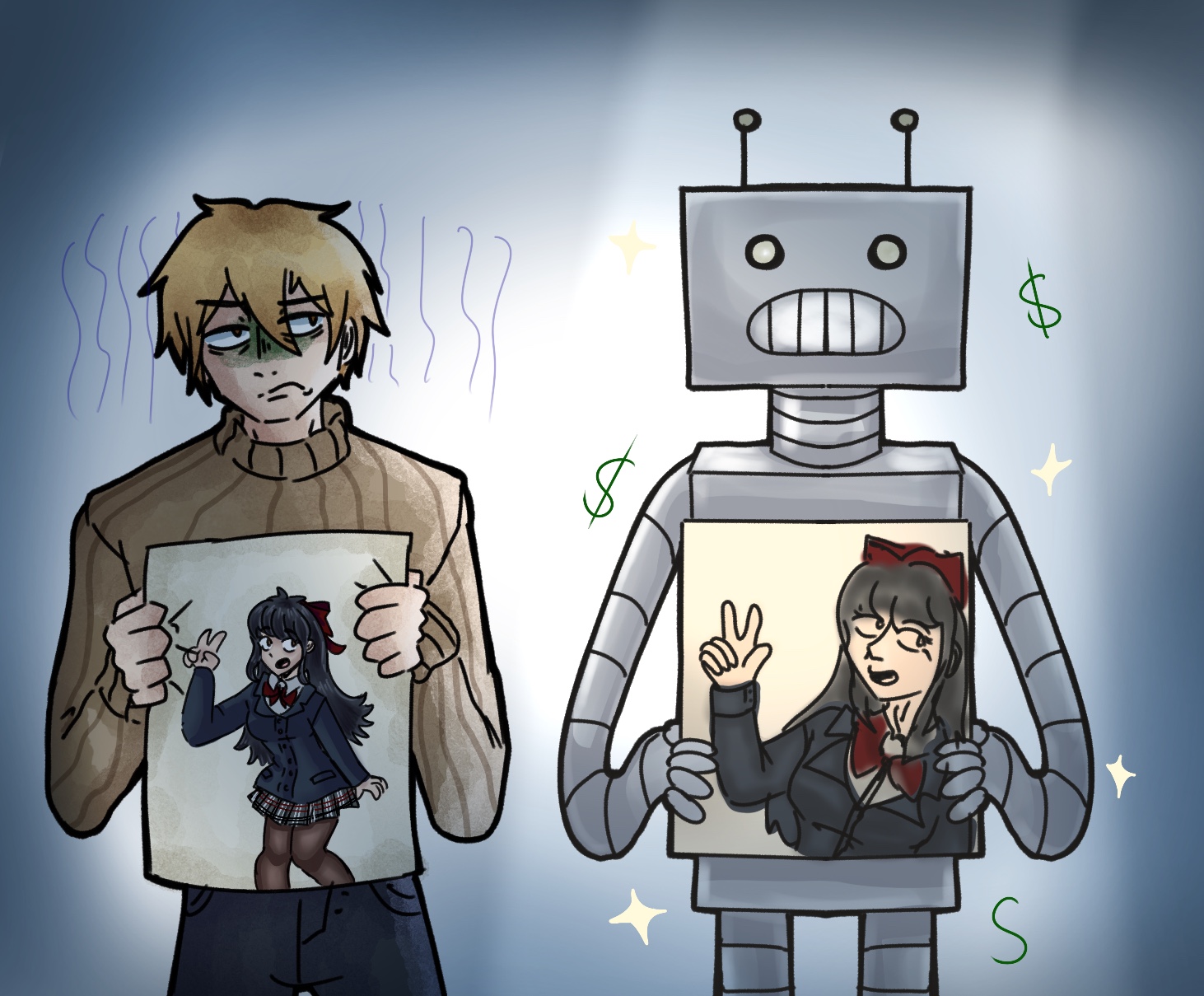

In today’s world, people always say that AI is taking people’s jobs. But is that true? And what job is the most affected by this rise of AI? Well, AI is harming digital artists. It is decreasing the market’s trust in artists, increasing the need for instant gratification, and causing the profits of the market to decrease.
AI is hurting artists by making consumers second guess if art is real and causing a decrease in popularity of the arts.
AI is increasing the desire for instant gratification, which is defined as the desire to experience pleasure or fulfillment without delay. Adam Grant, an organizational psychologist, said that there are 3 different types of people in a relationship. Those three types are givers, takers, and mathers. AI systems are givers, they require very little in return. If we become accustomed to not having to give anything in return, we will not have the patience for anything that requires that reciprocity. This information is from psychologytoday.com, explaining that when the human brain is exposed to a way of doing things that is easier than others previously known, it will adapt to take that shortcut. This affects art because if you were to go out and buy a commission from a real artist, it would take weeks for that photo to come back to you, while if you were to generate an image using AI, you would have it in minutes. The relationship between an artist and a consumer needs reciprocity. You have to pay the artist and give grace with timelines, as well as you have to credit them if you use that art anywhere else. With AI, it’s mostly free, automatic, and doesn’t need the credit.
Rise of AI ‘art’ is making the public question the validity in art, effectively diminishing the value of the art. Studies from the NIH show that people are negatively biased when it comes to AI vs human art. If there is knowledge of a human engaging in the artistic process, the appraisals of the art are positively effected. This quote explains that when you accuse something of being AI, the value automatically decreases, and with the rise of AI, trust decreases vastly.
The profits of art are decreasing due to AI, especially in digital art. UNESCO warns that after monitoring 120 countries, AI is projected to significantly decrease the income for artists in 2028. The report states that this decrease is occurring at a pace that outstrips current policy responses and increases inequalities and threatens the livelihood of millions of people. This is risking putting so many cultural workers out of a job. People cannot continue to make art full time if their incomes decrease.
Some people argue that AI makes art accessible, But in reality, the definition of art in itself includes human made according to Oxford dictionary, where they stated art is “the expression or application of human creative skill and imagination, typically in a visual form such as painting or sculpture, producing works to be appreciated primarily for their beauty or emotional power.” We also have examples of famous artists, such as Beethoven, who were disabled. Beethoven, a brilliant musician, was deaf.
Make sure to watch out for AI, but if an artist proves they are not using AI either through a speedpaint (a sped up video of an artist drawing their piece either through the app they drew the piece on or physically recording it) or any other method, please support them in any way you can. Even just liking the video can help.
AI is harming artists and creating mistrust in the community by hurting profits and decreasing trust.